


BADGES
Curiosity Untamed, Frontier Girls and Quest Clubs all use the same badges. We offer over 1,000 badges in nine different Areas of Discovery. Whether your passion is for the outdoors, the arts, or just exploring the world, we have a badge for you!
Click on an Area of Discovery to be taken to that page.
Click here for the Complete Alphabetical Badge List
Keep in mind that some badges may qualify for two or more Areas of Discovery depending on your focus. For example, if you earn the Biographies badge by learning about Albert Einstein, it could fall under Discover Science & Technology, while earning it by learning about Vincent van Gogh could fall under Discover Art.
Many badges are written with general requirements that can be customized to explore a more specific topic. For example, the Animals badge can be used to study a particular animal, while the Book badge can be used with a book of your choice. With well over 1,000 badges and the ability to customize many of them, the possibilities are nearly endless.
Badge requirements become progressively more challenging as children grow. While we provide requirements for each badge, they can be adapted when necessary to meet the needs and abilities of individual girls. We believe almost anything can be educational, so the curriculum covers an enormous range of subjects while leaving controversial topics that are better addressed by parents or religious leaders to individual families.
How to Earn Badges

Most badges include around 30 requirements designed to work across a wide range of ages. The number of requirements needed to earn a badge depends on the participant’s age level. Younger girls complete fewer requirements, while older girls complete more and are expected to demonstrate greater knowledge, independence, and skill.
The same requirement should look very different depending on the age of the girl completing it. A younger girl may need considerable help from an adult, while an older girl completing the same requirement should be able to do more independently and demonstrate a deeper understanding of the subject.
For example, a younger girl learning beading might be working with pony beads and simple patterns while older girls might be working with seed beads and more complex patterns. This allows girls of different ages to work on the same badge together while still being challenged at an appropriate level.
Badge requirements provide a framework for learning about a subject and may be adapted when necessary to meet the needs and abilities of individual girls. The goal is for each girl to learn something new, develop useful skills, and be appropriately challenged for her age and ability.
Re-Earning Badges At a New Level
Girls may earn the same badge again as they move to a higher age level. When re-earning a badge, any required lower-level requirements must still be completed. For knowledge-based requirements, a girl may demonstrate that she still remembers and understands what she previously learned rather than starting over. For skill-based requirements, she should demonstrate the skill at a level appropriate for her current age and ability.
Girls are encouraged to choose different optional requirements when re-earning a badge so they can explore new aspects of the subject, but they may repeat requirements they completed previously if desired. When a requirement is repeated, greater knowledge, skill, or quality of work should be expected at the higher level.
Repeating important concepts and skills as girls grow helps reinforce what they have already learned while allowing them to build on that foundation with more advanced knowledge and abilities.
What Do Badges Look Like?


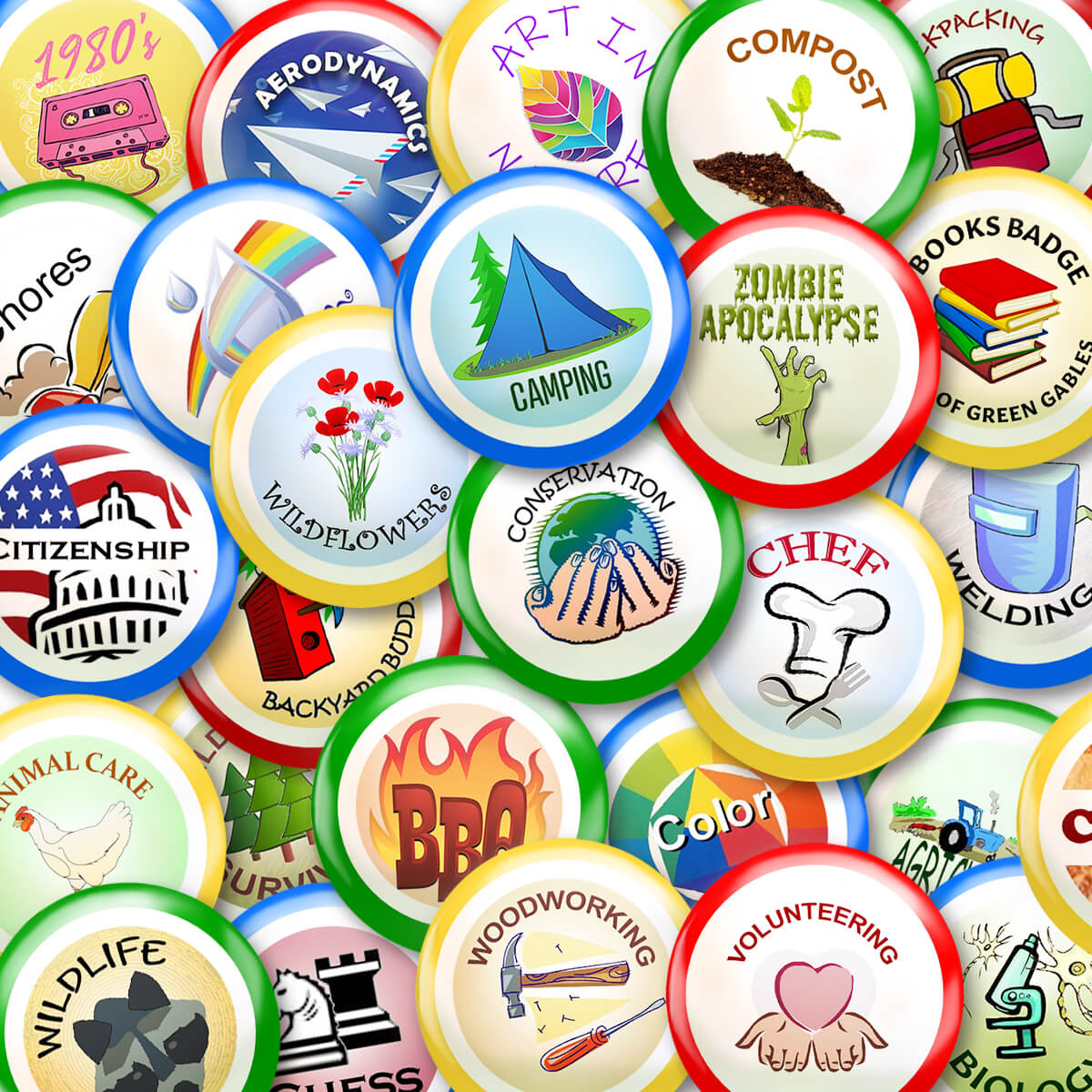
Frontier Girls badges are 1 1/4″ steel spring-back button-style pins rather than patches. The colored ring around the outer edge represents the age level at which the girl earned the badge.
The pin style makes badges easy to display immediately without sewing and allows them to be moved or rearranged as needed. Badges should be displayed on a Frontier Girls uniform with excess badges placed on a backpack or tote bag, in a shadow box, on a bulletin board, or anywhere else the pins can be securely attached.